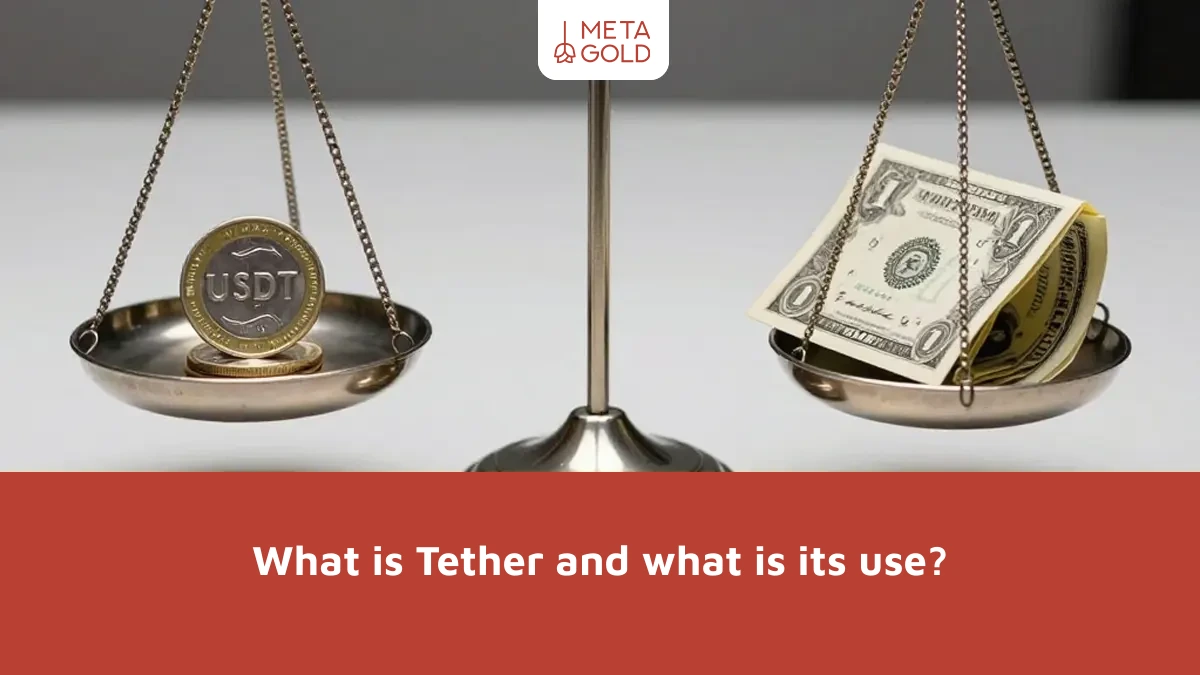

In answer to the question of what Tether is, it should be said that Tether is one of the most well-known stablecoins in the cryptocurrency market. More than 50% of daily cryptocurrency trading volume is conducted with Tether. Tether is one of the few digital currencies that has largely remained unaffected by the inherent volatility of the cryptocurrency market.
For cryptocurrency traders, Tether is the best alternative to the dollar for trading on the blockchain. But why has Tether attracted the attention of traders, and why is it referred to as the digital dollar? What feature makes Tether the first choice for traders to buy and sell various cryptocurrencies and even invest? In these articles, we answer these questions of what Tether is and what its use is.

What is Tether cryptocurrency in simple terms?
In answer to the question of what Tether is and what its use is, it should be said that Tether is a stablecoin issued by the Tether company. This project was introduced in 2014 and was initially known as RealCoin, but since November 2014, it has become widely recognized as Tether with the symbol USDT in the market.
The Tether company announced in January 2025 that it has officially relocated its headquarters to San Salvador, El Salvador, and has received the necessary licenses to operate in the digital asset sector from this country.
Tether is a stablecoin; a stablecoin is a type of cryptocurrency designed to combat volatility and create a stable environment. The value of a stablecoin remains as constant as possible.
What is the symbol of Tether in cryptocurrency? Tether is represented by the symbol USDT in the markets. Since the price of one Tether is usually equivalent to one dollar, it often plays the role of a digital dollar for many.
The difference between Tether transfer networks and their importance.
When buying and selling Tether, you may encounter different network names. Keep in mind that Tether only has one version, and the differences in networks are related only to the transfer platform. In fact, USDT can be issued on different blockchain networks and transferred on the same network.
So when we say “Tether on Tron” or “Tether on Ethereum,” we don’t mean that Tether has changed; we mean that the transfer path is different.
For the user, the difference between networks usually manifests in two things:
- Transfer speed.
- Transaction fee amount.
Some networks are cheaper and faster, while others are more congested and expensive. For this reason, when depositing or withdrawing Tether on exchanges, they usually ask you to choose the “transfer network.”
The most important point is that when transferring Tether, the source and destination networks must be the same.
Tether (USDT) is issued as separate tokens on different networks; for example, USDT-TRC20 on the Tron network and USDT-ERC20 on the Ethereum network. When you have “Tether Tron,” it means your asset is on the Tron network and should only be sent to a Tron address.
If you make a mistake and send USDT-TRC20 to an Ethereum (ERC20) address, the deposit will not be completed, and the asset may get stuck or be difficult, or even impossible, to recover (depending on the destination wallet).
Therefore, USDT on Tron can only be transferred to a Tron address, and USDT on Ethereum can only be transferred to an Ethereum address. Keep in mind that Ethereum addresses start with “0x,” while Tron addresses start with “T.”
What is the purpose of creating Tether and what is its use?
The cryptocurrency market is always volatile. This volatility creates opportunities for some, but for many, especially during trading, it is a real challenge.
If you are in the middle of a trade and the market suddenly crashes, you may not want to convert your assets into bank dollars, but you also don’t want to stay in that volatility. This is where having a low-volatility tool within the same ecosystem becomes very valuable.
Tether was created with this goal: to provide a relatively stable unit that users can use to temporarily stabilize the value of their assets without leaving the crypto market. On the other hand, many traders measure their profits and losses in USDT, effectively considering Tether as the base for their decision-making.
How does Tether maintain its price close to 1 dollar?
Tether is designed to maintain its value close to one dollar. This “staying close” is usually explained by the concept of being pegged to the dollar; meaning the market expects each unit of USDT to be backed by approximately one dollar.
However, in practice, it is not always the case that one Tether is exactly equivalent to one dollar. In certain market conditions, the Tether rate may be seen slightly higher or lower for a short period of time. However, compared to Bitcoin and altcoins, its volatility is noticeably lower.
What is the reason for Tether’s price stability?
- Market trust
- High liquidity
- Trader behavior
When the price of Tether moves slightly away from the equilibrium range, an arbitrage opportunity usually arises. Traders take advantage of the price difference of Tether on different trading platforms and trade until they make a profit. This movement causes the price to return to the range close to 1 dollar.
In simple terms, the market itself has enough motivation to maintain the value of Tether because it has become a cornerstone of daily transactions.

5 most important uses of Tether
Next, we will mention the most important uses of Tether:
1. Temporarily preserving the value of capital with a stablecoin.
Many traders, when they want to distance themselves from volatility, convert their assets to USDT to prevent their value from fluctuating sharply. This makes decision-making more rational and helps avoid impulsive choices.
2. Transferring value between exchanges and wallets.
Since Tether can be transferred across different networks and most exchanges and wallets support it, it is a common option for moving assets between platforms. This makes the transfer of funds easier and faster.
3. Unit of pricing in the market.
On the other hand, Tether also plays the role of a pricing unit in the market. In many exchanges, you see the prices of currencies with Tether trading pairs, which makes understanding the value of an asset easier. Instead of converting the price to real dollars every time, you directly compare it with USDT, allowing you to make decisions more quickly.
4. A substitute for the dollar for payments and account top-ups on platforms.
Some foreign services and platforms require dollar payments, but due to sanctions and the limitations of credit cards and international payment systems, direct access is difficult. In this case, Tether can play the role of a “digital dollar on the blockchain” for transfers and payments.
5. A substitute for the dollar for value storage.
Many users buy and hold USDT instead of purchasing and storing physical dollar bills to preserve the value of their assets in dollars, because buying, holding, and transferring Tether is easier than dealing with physical dollars.

What is Tether cryptocurrency and how does it differ from Bitcoin?
Tether and Bitcoin are completely different in terms of “purpose.” In the article “What is Bitcoin,” we discussed that BTC is a digital asset often referred to as digital gold because it has a limited supply, and its value is primarily determined by supply and demand. Bitcoin is highly volatile and is suitable for long-term profit or high-risk trading.
Bitcoin and Tether are also different in terms of their nature. Tether is dependent on an issuing entity, and the decisions and policies of that entity can have an impact in specific situations. Bitcoin, on the other hand, has a more decentralized structure and is not controlled by any issuing company. Therefore, choosing between Tether and Bitcoin is not about “better or worse”; it’s about choosing the “appropriate use.”
Tether is suitable for short-term risk management and daily market operations, while Bitcoin is a good choice for dealing with volatility and benefiting from long-term growth.
In a nutshell, in the cryptocurrency market, Tether is a tool for buying and selling, while Bitcoin is an asset for investment. These two are not substitutes for each other.

What are the advantages and disadvantages of Tether?
In the table below, we will briefly review the advantages and disadvantages of Tether:
| Advantages | Disadvantages / Challenges |
|---|---|
| Less volatility, good for parking capital | May deviate from $1 under certain market conditions |
| High liquidity, easy to convert on exchanges | Risks related to backing and market trust |
| Common pricing unit in the market | Possible restrictions in some countries/exchanges |
| Fast and flexible transfers across networks | Risk of transfer errors (wrong network can cause loss) |
| Easier digital storage and portability than physical dollars | Requires security measures (wallet, address, network) |
What does “depeg” of Tether mean? Reasons for Tether moving away from 1 dollar.
One of the risks in the Tether project is depeg. Depeg means that Tether trades slightly above or below 1 dollar for a period of time. This deviation is usually caused by market conditions, such as a sudden increase in sell orders, reduced liquidity on an exchange/network, or users’ concerns about the backing and redemption process.
In practice, Tether often fluctuates close to 1 dollar, but no stablecoin guarantees a fixed price 100%. If your goal is “capital parking,” consider diversifying your investment, paying attention to the liquidity of trading pairs, and avoiding holding all your capital in a single asset.

Final summary: Tether, a low-volatility tool for traders.
Tether (USDT) is a widely used stablecoin created to provide a low-volatility unit close to the dollar in the cryptocurrency market. For this reason, it plays a key role in trading, value transfer, and pricing.
If you use Tether with the right purpose, it can be a very useful tool for managing capital in the volatile crypto market. However, you must also take its risks seriously, especially the market trust risks, which can cause small fluctuations. In the end, always pay attention to the source and destination networks when transferring Tether to avoid losses.
Keep in mind that you can always use Tether to fund your account on MetaGold and make CFD trades as well.
The most important questions about USDT:
1. What is Tether and what is its use?
Tether is a stablecoin whose price is usually close to 1 dollar. This stablecoin is used for trading, value transfer, and managing volatility risk in the crypto market.
2. Why is Tether called a digital dollar?
It is called a digital dollar because its value is usually close to the dollar and it plays the role of the dollar in the crypto market; meaning it serves as the pricing benchmark and trading tool for many users.
3. On which networks is Tether available?
Tether is available on multiple networks, such as Ethereum and Tron. When transferring, the source and destination networks must be the same.
4. What is the difference between Tether and Bitcoin?
Bitcoin is a volatile asset and may experience significant growth or decline, while Tether is designed for price stability, with the goal of maintaining a value close to the dollar.
5. What is the biggest risk of Tether for users?
The most important risk for regular users is usually choosing the wrong network or sending to the wrong destination.