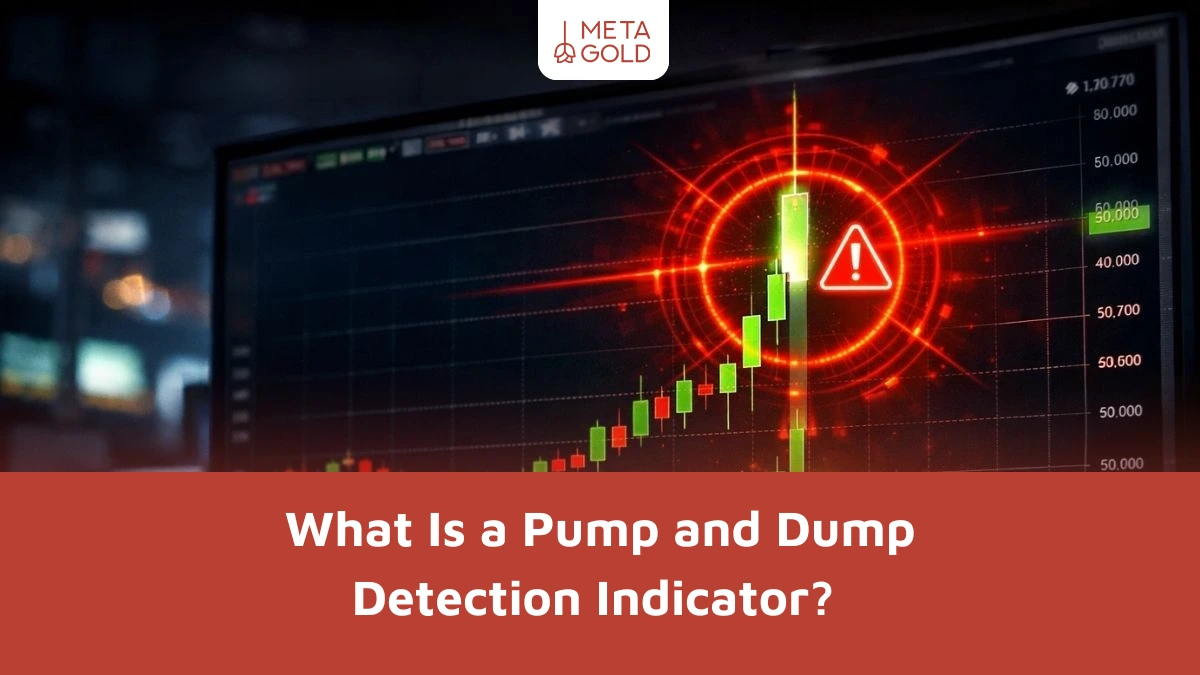

In the cryptocurrency market, many traders encounter sudden price movements that can lead to significant profits or heavy losses within just a few minutes. Determining whether a rapid price increase marks the beginning of a genuine trend or is part of a manipulation scenario is not always straightforward. This is where using a pump and dump detection indicator becomes important.
These tools aim to identify unusual market behavior by simultaneously analyzing price, volume, and volatility. In this article, we will examine the technical logic behind these indicators, explain the structure of the Pump & Dump Detector and the APDI indicator, and finally analyze their advantages, limitations, and practical application in trading.
To better understand this concept, it is recommended that you first read the article “What Is Pump and Dump?”
What Is a Pump and Dump Detection Indicator?
At a technical level, every pump and dump detection indicator is built on a simple statistical principle: under normal conditions, the market follows a “normal behavioral pattern,” and a pump or dump occurs when that pattern is significantly disrupted.
But what exactly does “normal behavior” mean?
In other words, price, volume, and the trading range move around their average levels within a specific time frame. The market may be bullish or bearish, but its changes are gradual and remain within the boundaries of its previous structure.
A pump becomes more likely when several key variables move outside this framework at the same time. This deviation can be measured across three dimensions, which we will examine below.
Price Acceleration
A 0.5% to 1% increase in a 5-minute candle may be normal for a large-cap coin. However, a 3% to 5% surge within the same period, without any clear fundamental news, is a sign of deviation.
The indicator measures this change against the average of the asset’s previous price movements.
Suppose an altcoin has fluctuated by an average of 0.3% to 0.8% on the 5-minute timeframe over the past week. If a candle suddenly forms with a 4% increase, that move is more than 4 to 5 times greater than its usual behavior.
At this point, the first warning flag is raised.
Abnormal Volume Spike
Price alone does not provide enough information. If a 4% increase occurs with normal volume, the move is likely to be temporary. However, if that same candle forms with volume two or three times higher than the average of the last 20 candles, it indicates that new capital may be entering the market.
Indicators compare the current volume with a moving average. If volume exceeds a predefined multiplier, such as 1.8x or 2x, it is registered as a spike.
Range Expansion
Under normal conditions, the distance between the high and low of each candle usually remains within a specific range. Pump movements are often accompanied by candles whose ranges are noticeably larger than the recent average. This indicates a sudden increase in buying or selling pressure.
Some indicators use ATR or its normalized version, NATR, to quantify this expansion. When the current ATR exceeds its average by a predefined multiplier, the abnormal increase in volatility is confirmed.
Introduction to the Pump & Dump Detector: Technical Structure and Detection Algorithm
The version known as Pump & Dump Detector (Sensitive) is a volatility- and volume-based scanner designed to identify strong market movements.
This tool is not a random combination of multiple indicators; rather, each of its components plays a specific role in validating the signal.
In this structure, the percentage change in price compared to the previous candle is analyzed first. This variable is considered the main trigger of the move.
However, this condition alone is not enough to activate a signal.
In the next step, the current volume is compared with the moving average of volume over a defined period. If the current volume exceeds the selected average by a specific multiplier—around 1.8x by default—a volume spike is detected.
This stage is highly important because many pump movements begin with an abnormal increase in trading volume.
The third factor is the analysis of the candle range, calculated as High – Low. A sudden expansion in this range may indicate a structural breakout or the triggering of liquidations.
The fourth component is NATR, or normalized ATR, which is calculated using the following formula: ATR divided by the closing price, multiplied by 100.
This normalization makes volatility comparable across different timeframes and assets. When NATR exceeds its smoothed average by a specific multiplier, the system registers an abnormal increase in volatility.
Finally, the minimum volume filter is applied to eliminate signals related to extremely illiquid coins. This filter is essential for reducing market noise.
The combination of these five analytical layers ensures that the final signal is not generated merely based on a simple price jump, but rather as the result of several statistical deviations occurring at the same time.
What Is the APDI Indicator and How Is It Different?
The APDI indicator, which is referred to in some versions as the APDI 10 indicator, follows a similar approach, but its main focus is on detecting the early stage of a move.
This tool attempts to identify the initial signs of acceleration before a pump reaches the confirmed stage.
The logic behind APDI is based on comparing the current behavior of price and volume with the historical pattern of the same asset. Instead of relying solely on a fixed threshold, it evaluates deviations from the asset’s average behavioral pattern.
As a result, the indicator becomes more sensitive in calm markets, while applying stricter filters in highly volatile market conditions.
In pump and dump indicator training, it is emphasized that APDI’s early signals are not sufficient for direct entry on their own. Instead, they should be analyzed alongside the trend structure, technical levels, and overall market conditions.
How to Use a Pump and Dump Detection Indicator in Trading
Effective use of these indicators requires a systematic approach. After adding the tool to the chart, alerts can be enabled for four conditions: early pump, confirmed pump, early dump, and confirmed dump.
An early signal indicates that abnormal conditions are beginning to form, while a confirmed signal means that multiple filters have been triggered simultaneously.
Depending on their strategy, traders can choose one of three approaches: trading the breakout, entering on a pullback, or using the signal purely as an alert to avoid emotional entries.
To access different versions of this tool, users can also visit the Forex indicator download page, which provides a collection of practical indicators.
Advantages of a Pump and Dump Indicator and Its Role in Improving Trading Performance
If we evaluate the advantages of a pump and dump indicator realistically, its most important benefit is reaction speed. The human eye often notices abnormal changes with a delay, while an algorithm can detect statistical deviations immediately.
Another key advantage is the reduction of emotional decision-making. When traders know that a move has occurred under abnormal conditions, they are less likely to enter the market impulsively.
This tool is also more useful for short-term traders and scalpers who work with lower timeframes, as explosive price movements are more significant in these periods.
Disadvantages of a Pump and Dump Indicator and the Risks of Using It
Alongside its strengths, the disadvantages of a pump and dump indicator should also be considered. The first limitation is the possibility of false signals.
The release of positive fundamental news may create conditions similar to an artificial pump, and the indicator may not be able to distinguish between the two.
The second issue is relative lag under certain conditions. If the move is extremely fast, part of the price movement may have already occurred by the time all filters are triggered.
On the other hand, volume data quality is not always reliable across some exchanges. If real trading volume is not accurately reflected, any analysis based on that data may also become inaccurate.
Most importantly, this tool is not a substitute for risk management. Using it without a stop-loss or without considering the broader market structure can be harmful.
The Role of Machine Learning in Pump and Dump Detection
In recent years, several efforts have been made to use machine learning models for detecting market manipulation. Algorithms such as Isolation Forest have been used to identify outliers, while neural network–based models such as LSTM and GAN have been applied to time-series analysis.
The main challenge in this area is the lack of an official database of confirmed pump and dump cases. For this reason, many models are trained in an unsupervised manner and simply aim to identify unusual behavior.
Although this approach can be useful, it will always involve a certain degree of error.
In practical comparisons, classic anomaly detection methods have often shown more stable and interpretable performance than highly complex models.
Conclusion on the Pump and Dump Detection Indicator
A pump and dump detection indicator is a tool for identifying statistical deviations in price, volume, and volatility—not a tool for predicting the market with certainty.
Tools such as APDI or the Pump & Dump Detector are useful when they are used alongside trend analysis, market structure, and risk management. If these indicators are used purely as alert systems, they can help reduce emotional entries and improve risk control.
Before using them in live trading, make sure to adjust the settings based on the timeframe and asset type, and avoid acting on signals without technical confirmation.
Frequently Asked Questions About the APDI Indicator
1. What exactly does a pump and dump detection indicator measure?
This indicator simultaneously analyzes price changes, volume spikes, and abnormal increases in volatility. When these three variables move away from their normal behavior, a signal is generated.
2. Does an early pump signal mean a definite entry?
No. An early signal only indicates that abnormal conditions are beginning to form. Before entering a trade, the trend structure, technical levels, and confirming volume should be analyzed.
3. What is the difference between the APDI indicator and simpler versions?
APDI focuses more on detecting the early stage of a move. It compares the asset’s current behavior with its own historical average, rather than relying on a fixed threshold.
4. Can this indicator be used in all markets?
In markets with very low liquidity, the probability of false signals is higher. The indicator tends to perform more accurately on assets with stable trading volume and reliable data.
5. Can you trade using only this indicator?
No. This tool is a complement to technical analysis and risk management, and should not be used as the sole basis for trading decisions.