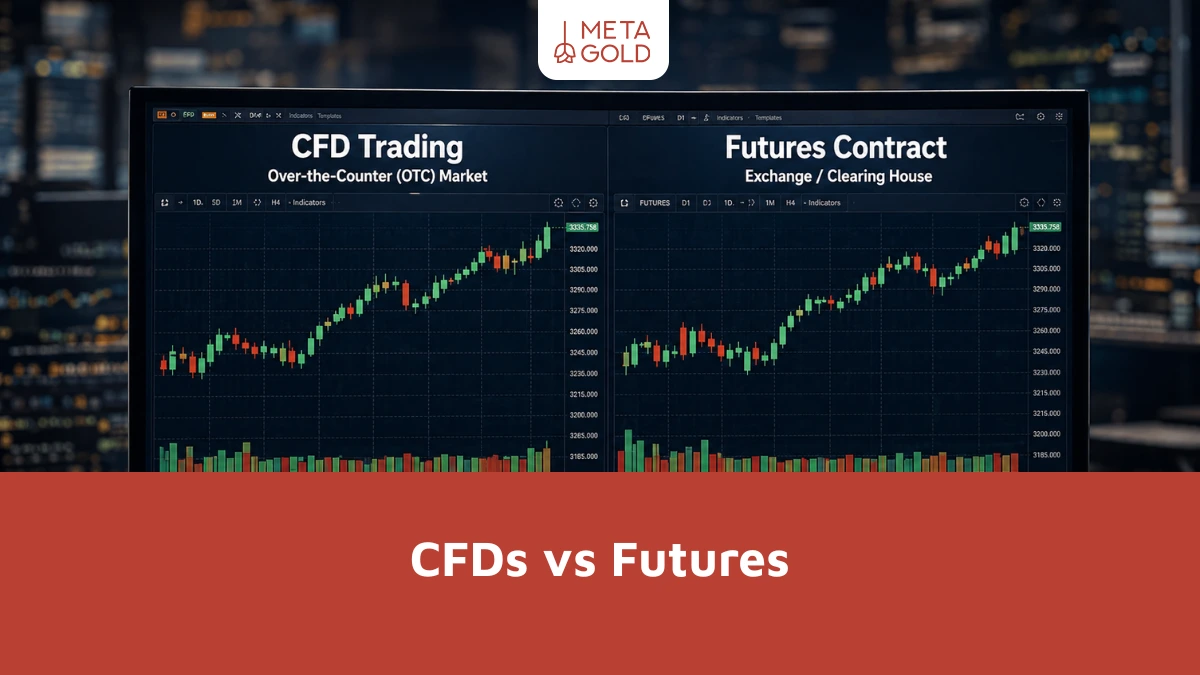

Entering the derivatives market without understanding the differences between the instruments can lead to making the wrong choice and increasing risk. Many traders compare CFDs and futures to decide which instrument better suits their capital, strategy, and level of experience.
Both instruments allow traders to use leverage and potentially profit from price movements, but they have significant differences in terms of contract structure, settlement method, fees, and level of transparency. In this article, we compare these two instruments to help traders make a more informed decision based on strategy, risk tolerance, and market conditions.
What is the difference between CFDs and futures in terms of contract structure?
In CFDs, the trader and the broker agree to settle the difference in the price of the asset at the time of entry and exit of the trade. No transfer of ownership occurs and the contract is concluded over-the-counter (OTC) between the client and the broker. Position size is usually flexible, allowing traders to choose a volume that matches their capital.
In contrast, futures contracts have a standardized, exchange-traded structure. Each contract has precise specifications, including a fixed size, expiration date, and settlement method. These contracts are traded on official exchanges such as the CME, and a clearing house ensures that the obligations are fulfilled. This standardization ensures that all participants trade on the same terms.
In futures, the expiration date is an integral part of the contract; the trader must close the position before expiration or roll it over to the next month’s contract. In CFDs, there is no such restriction and the position can remain open without an expiration date, provided that overnight maintenance fees are paid.
Comparing asset ownership in CFDs and futures
In CFDs, the trader simply bets on price changes and never owns the underlying asset. Even if the subject of the trade is gold, oil or shares, no real asset is purchased. Profits and losses are calculated only based on the price difference and are settled in cash.
In futures, the contract creates a legal obligation to buy or sell an asset at a future date. Although most traders close out the position before expiration and do not enter into physical delivery, the contract structure allows for physical delivery or cash settlement. This difference makes futures a more serious hedging tool; for example, an airline can lock in the price of future fuel.
Therefore, CFDs may be more flexible for short-term speculation, while futures are often more effective for hedging structural risk.
Comparison of trading leverage in CFDs and Futures
Both instruments are margin-based and allow trading with less capital than the actual value of the contract. However, the way leverage is applied is different.
Simple example: If a trader opens a position worth $270,000 in gold with 1:50 leverage, he would pay only $5,400 in margin. A $50 increase in the price of gold per ounce could generate a profit of $5,000, which is a return of about 92% on the initial capital. But a decrease by the same amount would result in a loss of the same amount.
In futures, leverage is also applied through margin, but the level is set by the exchange and is more structured. For example, on a wheat contract worth $37,500, only $3,000 of margin may be required. A $0.50 change in price can result in a $2,500 profit or loss. Because of the fixed size of the contracts, careful risk management becomes even more important.
In terms of leverage, CFDs usually offer more flexibility in position sizing, while futures provide greater transparency and a more standardized structure.
Difference in costs between CFDs and futures
The cost structure of CFDs and futures is fundamentally different in terms of its components, how it is calculated, and its impact on the final return of the trade. This difference is especially important when choosing between short-term and long-term trading strategies.
In CFD trading, costs are a combination of implicit and explicit costs. The spread is paid as the difference between the buy and sell price at the moment of entry and moves the break-even point of the trade. In some accounts, in addition to the spread, a separate commission is charged.
But the most significant cost component in CFDs is the overnight financing cost. Since CFDs are traded on margin, holding an open position after the end of the trading day is subject to daily interest. This rate is calculated based on interbank rates plus the broker’s profit margin and can significantly reduce net returns in medium-term or multi-month trades.
In contrast, in futures, there is no daily financing charge. The concept of “Cost of Carry” is built into the price of the futures contract from the beginning; that is, interest rates, holding costs, and market expectations are reflected in the premium or discount of the contract. Traders generally pay brokerage commissions and exchange fees. In short:
- CFD: Spread + Commission (on some accounts) + Overnight Funding Fee
- Futures: Fixed exchange and broker commission + no separate daily fee
Comparing trading risks in CFDs and futures
The risk is high in both instruments, but its nature is different. In CFDs, there is counterparty risk. Because the transaction is done over-the-counter, the trader is directly contracting with the broker. If the broker experiences liquidity problems or goes bankrupt, there is execution risk. Pricing will also vary slightly between brokers.
In futures, counterparty risk is reduced due to the presence of a clearing house. The exchange guarantees contract execution and the price is the same for everyone. However, the large contract size and extreme volatility can lead to rapid margin calls.
In both markets, leverage is the main factor that increases risk. Small fluctuations can wipe out a large percentage of capital. Capital management and setting stop losses are crucial.
Are trading conditions better in CFDs or futures?
In terms of accessibility and ease of entry, CFDs are simpler for retail traders. The minimum capital requirement is lower and it is possible to choose much smaller volumes than standard contracts. In addition, the trader can access a wide range of markets through one trading account, including stocks, indices, forex, cryptocurrencies and commodities.
To better understand how this tool works, reading the article What is CFD Trading can provide a clearer view of its execution structure. These features have made CFDs popular among short-term traders and small accounts.
In contrast, futures require a higher initial capital. Each contract has a fixed size and notional value, and traders cannot adjust the contract size as freely as they can with CFDs. For this reason, in small accounts, the size of a contract may be large relative to the risk capacity. However, the main advantage of futures lies in deep liquidity, price transparency, and centralized rate discovery on official exchanges.
Futures or CFDs: Which is better for what type of trading?
The choice between these two instruments depends more on the trader’s strategy, risk management approach, and time horizon than on the market itself. Each instrument is better suited to specific trading scenarios.
- Short-term traders and scalpers: They may prefer CFDs because they offer flexible trade sizes, lower capital requirements, and fast execution across a variety of markets.
- Institutional traders and hedgers: Often choose futures because of price transparency, clearinghouse guarantees, and standardization of contracts. This structure is better suited for structured hedging and professional risk management.
- Medium and long-term strategies: When holding a position for several months, futures are more cost-efficient in terms of cost structure due to the lack of daily funding costs.
- Multi-market traders and small investors: For simultaneous access to stocks, indices, commodities and forex in a single account, CFDs are a simpler trading option.
Summary of the difference between CFDs and Futures
Understanding the difference between CFDs and futures is important when choosing an instrument that fits your strategy. If you are looking for flexibility in trading volume, a lower initial capital, and quick access to a variety of markets, CFDs can be a more practical option.
Conversely, if exchange transparency, standard contract structure, and medium- to long-term holding are your priorities, futures are a more logical choice. The answer to the question of whether CFDs or futures are better depends on your risk management, time horizon, and trading experience. Before entering any market, carefully review the cost structure and leverage levels.
Frequently Asked Questions About CFDs and Futures
1. What is the main difference between CFDs and futures?
The main difference is in the contract structure and the trading venue. CFDs are traded over-the-counter between a trader and a broker, while futures are traded on official exchanges with standard contracts.
2. Do we own the asset in CFDs?
No. In CFDs, ownership of the asset is not transferred and only the price difference between entry and exit is settled.
3. Which tool costs less to maintain long-term?
Futures are more cost-effective for long-term holding because they do not have daily financing costs like CFDs.
4. Is the risk in CFDs higher than in futures?
The nature of the risk is different. In CFDs there is counterparty risk, while in futures the clearing house guarantees the execution of the contract. However, both instruments carry high risk due to leverage.
5. Are CFDs or futures more suitable for small accounts?
In most cases, CFDs are more flexible for smaller accounts because they allow traders to trade smaller position sizes.