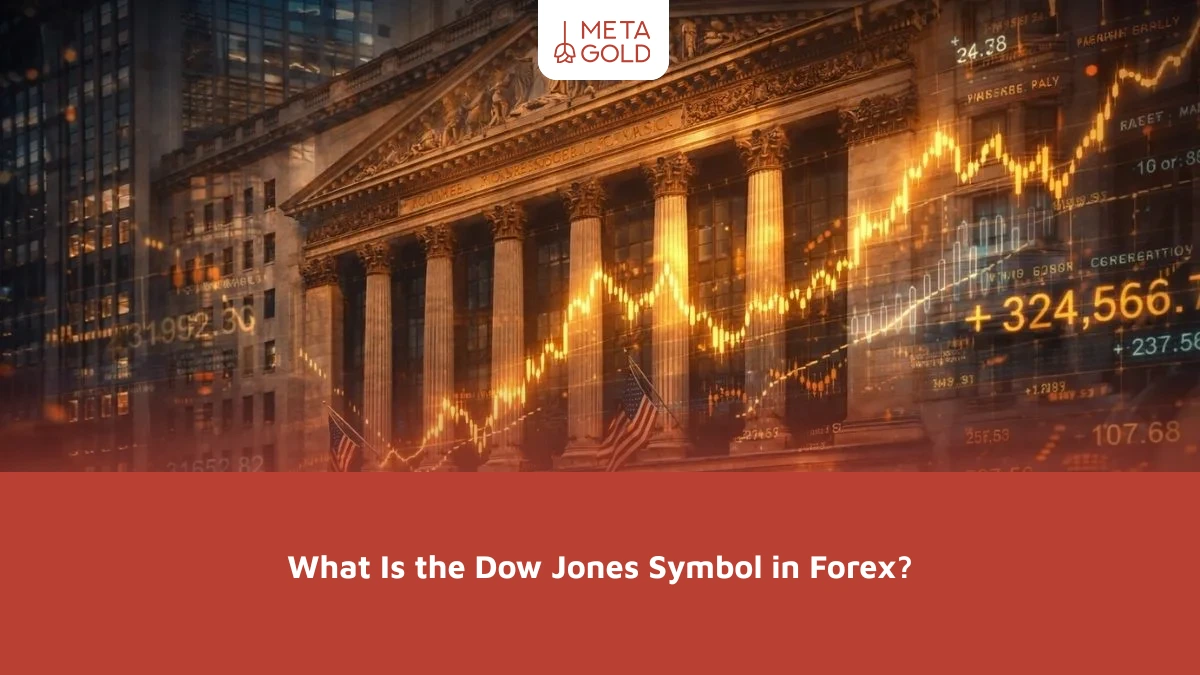

If you plan to trade global indices, you’ve probably wondered what the Dow Jones symbol is in Forex. And how is it different from stock trading? Many traders know that the Dow Jones is one of the most important U.S. stock market indices, but they may not fully understand its structure, how it is calculated, or how it is traded on platforms such as MetaTrader.
In this article, we will first examine what the Dow Jones Industrial Average is and why it matters, then explain how it is calculated, and finally clarify the differences between trading the Dow Jones Industrial Average in forex and futures. The goal of this guide is to provide a clear and practical picture for making informed decisions when trading the Dow Jones Industrial Average.
What is the Dow Jones Index and what is its importance in financial markets?
To answer the question of what is the Dow Jones index? We have to go back to 1896. The Dow Jones Industrial Average, also known as the DJIA or Dow, was introduced by Charles Dow and is one of the oldest and most widely followed stock market indices in the world. The index includes 30 large and reputable American companies from various economic sectors. It aims to provide a general picture of the health and performance of the US stock market. Companies such as Apple, Microsoft and Boeing are among the companies included in this index.
Initially, the index consisted of only 12 industrial companies. The initial companies included:
- American Cotton Oil
- American Sugar
- American Tobacco
- Chicago Gas
- Distilling & Cattle Feeding
- General Electric
- Laclede Gas
- National Lead
- North American
- Tennessee Coal and Iron
- US Leather preferred
- US Rubber
As time passed and the structure of the American economy changed, the composition of this index also changed and expanded to 30 companies.
Dow Jones Index Composition
The Dow Jones Industrial Average consists of 30 major U.S. blue-chip companies listed on the NYSE or Nasdaq. Its composition changes over time, so traders should always check the latest constituent list from S&P Dow Jones Indices.
The selection of companies for the index is done by a committee of members of The Wall Street Journal and S&P Dow Jones Indices. There is no set criteria or formula for selection, but companies must have “sustainable growth,” “excellent reputation,” and “importance to a broad range of investors.”
In classical market analysis, concepts related to market trends and structure, which were later introduced in the form of Dow Theory , have had a great influence on the formation of the analytical view of this index.
What is the Dow Jones symbol in Forex and how is it traded?
In the forex market, you do not directly buy the stocks that make up the Dow Jones. Instead, most retail platforms offer Dow exposure through CFDs that track the price movement of the index. This means that instead of owning the underlying asset, the trader simply takes a buy or sell position on its price changes.
In this structure, traders speculate on the price movement of the index rather than owning the underlying stocks of the 30 Dow components. So your profit or loss is calculated from the difference between the entry and exit prices. This is the same logic as in CFDs, a tool that provides high flexibility to trade in both directions of the market (up and down).
In most brokers, the Dow Jones symbol is displayed in MetaTrader with titles such as US30 or Dow30, and users can activate it from the Market Watch section. The difference in naming is purely a matter of broker policy, but the essence of the instrument is the same: trading on an index representing the 30 largest US companies.
The advantage of this structure for the Forex trader is easy access, the ability to use leverage, and trade in a variety of sizes without the need to directly manage a portfolio of stocks.
How is the Dow Jones Index calculated?
One of the most important parts of understanding this index is understanding how the Dow Jones Index is calculated. The index uses a “Price-Weighted Average” method. In this method, the total stock price of all 30 companies in the index is calculated and then divided by a number called the Dow Divisor.
The general formula is as follows:
DJIA =
Sum of Stock Prices
Dow Divisor
- Constituent stock selection: 30 large companies are selected from various economic sectors.
- Stock Price Sum: The current price of all 30 shares is added together.
- Dow Divisor Calculation: A number that is adjusted to maintain index continuity after events such as stock splits, special dividends, spin-offs, or changes in index constituents.
- Dividing the sum of prices by the Dow Divisor: The result of this division determines the value of the index.
The important thing to note is that in a price-weighted index, stocks with higher prices have a greater impact on the index. For example, if two Dow components move by the same percentage, the higher-priced stock will usually have a larger impact on the index because the Dow is price-weighted. This feature causes companies to be weighted based on their share price, not their market value. This is an important difference from indices like the S&P 500, which are calculated based on market capitalization.
Differences between Dow Jones trading in Forex and Futures markets
The Dow Jones Industrial Average is traded in both the derivatives market and futures contracts, but the structure of these two markets differs significantly. To explain it very briefly, What are futures?A futures contract is a standardized agreement to buy or sell an asset at a specified future date at a predetermined price. These contracts have a maturity date and their specifications are quite standard in terms of contract size, collateral, and transaction time.
In the futures market, traders trade standardized contracts with specific expiration dates, contract sizes, margin requirements, and exchange-defined trading hours. In contrast, in the forex market, the Dow Jones Index is primarily offered through CFDs, meaning that the trader takes a position on the price difference of the index rather than entering into a standard futures contract.
For example, the Dukascopy platform offers a product called USA30.IDX/USD, which is a CFD contract and its price is correlated with the Dow Jones futures contract for the next month. One of the advantages of this structure is the ability to trade in fractional sizes such as 0.1 lot, which is equivalent to a mini contract.
Unlike exchange-traded futures, CFDs are broker-provided instruments, so their trading hours, contract size, spreads, and overnight fees depend on the broker. Dow futures themselves are not limited to regular U.S. stock market hours.
Why do forex traders love the Dow Jones?
After we understand what the Dow Jones Index is And once we get to know the mechanism of its calculation, a more important question arises: why is this indicator so attractive to Forex traders? The answer must be sought in its economic position, historical background, and psychological role in financial markets.
1. Historical significance
The Dow Jones is one of the oldest stock market indices in the world, having been published since 1896. This long history has made it a classic measure of the state of the American market. Many analysts use the historical behavior of this index to understand economic cycles and compare booms and busts.
2. Economic Health Index
Because the index includes 30 large, established American companies, its movements are often interpreted as a reflection of the overall health of the U.S. economy. A rise in the index can be a sign of economic strength, while a fall is sometimes seen as a sign of economic weakness or concern.
3. Impact on investor sentiment
Significant movements in the Dow Jones usually affect market sentiment. Strong rises can boost investor confidence, while sharp declines can cause caution or capital outflows.
4. The impact of macroeconomic factors
Interest rates, inflation, government policies, global events, and technological advances can all affect the performance of an index. For example, a decline in interest rates may boost investment and have a positive impact on the index, while high inflation or geopolitical tensions can create negative pressure.
However, it should be kept in mind that the stock market is inherently unpredictable and these factors can affect the index in complex and simultaneous ways.
Conclusion
The Dow Jones Industrial Average is one of the oldest benchmarks for measuring the US stock market, calculated through a price-weighted structure. Understanding what the Dow Jones Industrial Average is and knowing How to calculate the Dow Jones index It helps you analyze its movements more logically. In the forex market, this index is usually offered as a CFD on retail trading platforms. If you plan to trade it, you should first understand how CFDs differ from futures contracts and check the trading conditions of your broker.
FAQ
What is the Dow Jones Index?
The Dow Jones Industrial Average (DJIA) is a stock index of 30 large American companies used to measure the overall performance of the US stock market.
What is the Dow Jones symbol in Forex?
In Forex, the Dow Jones is usually offered as a CFD contract with symbols such as US30 or Dow30, and the trader trades on its price volatility.
How is the Dow Jones Index calculated?
This index is calculated using a price-weighted method; the total price of the 30 index member stocks is divided by a number called the Dow Divisor.
What is the difference between Dow Jones in Forex and Futures?
In the futures market, contracts have a fixed maturity; however, in Forex, CFDs are commonly used, which offer greater flexibility in transaction size and timing.
Why is the Dow Jones important to traders?
Because it is known as an indicator of the health of the US economy, and its changes can affect investor sentiment and trading decisions.