
What factors influence the choice of the best time frame for trading futures contracts?
Choosing the right time frame for trading futures is a fundamental decision in any trader’s strategy, as the chart’s time frame influences the type of analysis you use, your entry and exit points, and your approach to risk and trade management. There is no single “Best Time Frame for Futures” that suits all traders; rather, it should be determined based on several important factors:
1. Type of financial asset: cryptocurrencies, commodities, or indices
Every market has its own time-related characteristics. In cryptocurrency futures contracts, high volatility and high liquidity may make short time frames—such as one minute to five minutes—more suitable for scalping and short-term trading.
Conversely, some commodity markets or indices may move at a relatively slower pace, so it makes more sense to use the four-hour or daily time frame to identify medium-term trends.
2. The trader’s risk tolerance
If you’re able to tolerate risk and handle short-term volatility, short-term time frames may be a suitable option. However, traders seeking more disciplined decisions and a more measured analysis will rely on longer time frames, such as daily or weekly. The longer the time frame, the less impact price noise has, and the clearer the overall picture of the market trend becomes.
3. Trading Volume and Liquidity
In large markets, price data over short time frames is more reliable. For low-liquidity assets, however, short-term movements can be misleading, and it makes more sense to use medium-term time frames.
4. The Trader’s Goal: From Short-Term Trades to Longer-Term Positions
If your goal is to execute a few trades per day, short time frames, such as 5 or 15 minutes, are a good tool for tracking rapid price movements. For swing trading—or trades that last for days or weeks—the 4-hour and daily time frames may be more suitable for this approach. For this reason, the optimal time frame for trading futures varies from trader to trader and should be chosen based on your personal trading style and goals.
Ultimately, the most appropriate approach is one that balances the accuracy of the analysis, the speed of decision-making, and the trader’s ability to stick to the plan. Understanding these factors will help you determine the right time frame for you and obtain more reliable signals from price data.
The Impact of Time Frame on Three Common Styles of Futures Trading
In futures trading, choosing the right chart time frame is an essential part of defining your strategy. The optimal time frame for futures always depends on the trading style; each trading style operates at a different pace and follows a different logic, and it must align with the time frame to yield clearer insights and more disciplined trading decisions.
In this section, we’ll cover three common strategies: scalping, day trading, and swing trading.
1. Scalping: The Best Time Frame for Short-Term Trading in Futures Contracts
The scalping strategy focuses on extremely short-term trading and aims to profit from minor price fluctuations. With this approach, traders enter and exit the market within a short period of time, so very short time frames—such as one minute to five minutes—are best suited for this strategy.
In these time frames, rapid price movements and high trading volume are key factors, and indicators must be up-to-date and sensitive. For more details, see the article “The Best Time Frames for Short-Term Trading.”
2. Day Trading: The Best Time Frame for Day Trading
Day trading relies on intraday market fluctuations. Traders typically open and close their positions within the same trading day, capitalizing on short-term price movements. Time frames ranging from 15 minutes to one hour are popular choices, as they provide a clearer view of intraday price action while reducing noise compared to shorter time frames.
This approach requires quick decision-making and focuses on short-term market movements while avoiding the extreme speed of scalping. For more details, see the article “The Best Time Frames for Day Trading.”
3. Swing Trading: Medium- to Long-Term Time Frames
Swing traders typically hold their positions for several days or weeks, capitalizing on significant price movements. To achieve this, the 4-hour and daily time frames are suitable options. These time frames provide sufficient data to identify the primary market trend and appropriate reversal points in futures contracts. Because longer time frames generally contain less market noise, technical analysis can provide a clearer view of price trends, and psychological pressure is often lower compared to very short time frames.
Multiple Time Frames in Futures Trading; How Can Different Time Frames Be Combined?
Using an appropriate time frame for futures contracts can be helpful, but professionals understand that a smart combination of different time frames—known as multi-time-frame analysis—helps you make more accurate and disciplined entry decisions. This strategy helps you understand the big picture of the market and obtain the fine details needed to enter a trade. If you’d like to know why this approach is effective, we recommend that you first read the article “What Is Multi-Time-Frame Analysis?”
Trend Analysis on Higher Time Frames
The first step in the multiple time frame methodology is to use longer time frames (such as the daily, four-hour, or weekly time frames) to identify the overall market trend. At this stage, the concept of the “Best Time Frame for Futures” helps you choose the time frame that clearly shows the main trend, free from short-term fluctuations and market “noise.”
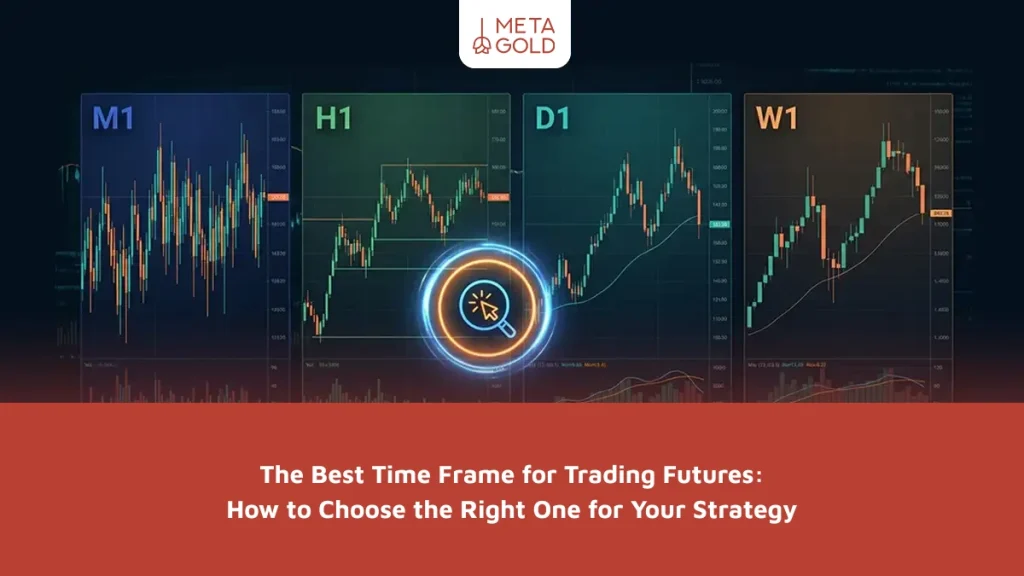
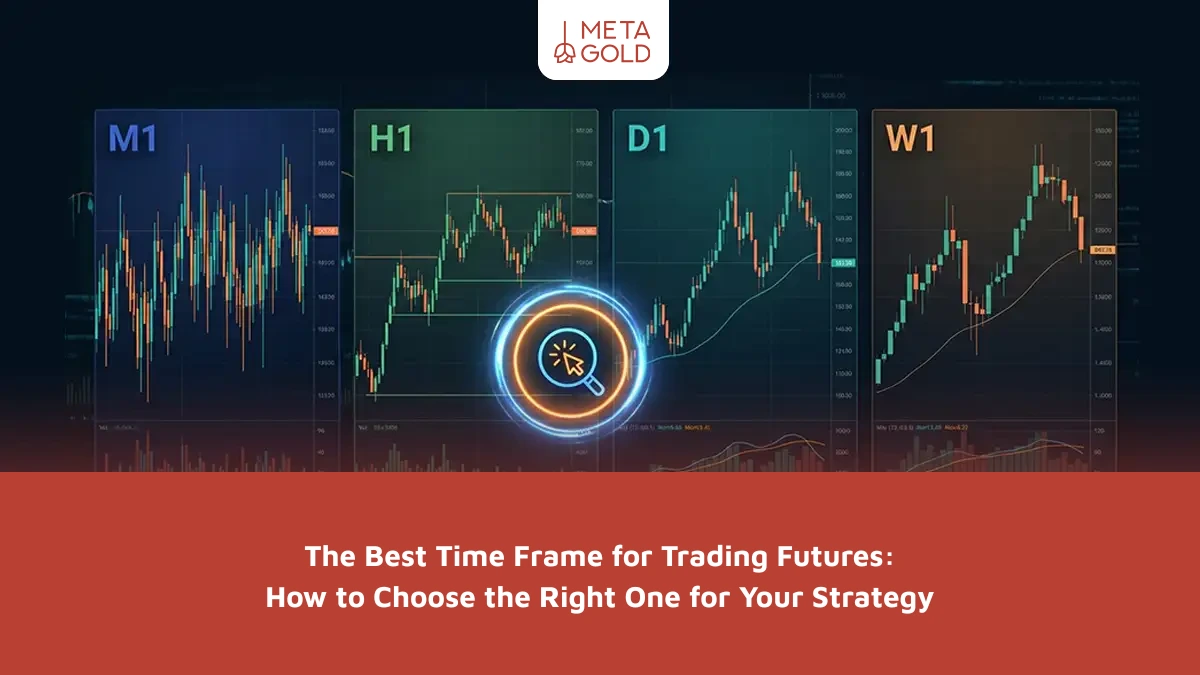
Let’s say you’re a scalper and you’re preparing to open a short position on the 1-minute (M1) timeframe. The M1 chart may show a decline in price or a short-term sell signal. However, if you check the higher time frame, such as the weekly chart, you’ll notice that the price is approaching a strong weekly support zone.
In this case, the sell signal on the M1 time frame may simply be price noise or a short-term correction against the main uptrend on the H1 time frame. Using a higher time frame (H1) helps you avoid entering risky trades that simply run counter to the overall market trend.
This long-term analysis will define the overall framework for your trading and prevent you from entering trades that run counter to the main market trend.
Precise Entry Within a Short Time Frame
After identifying the main trend on the higher time frame, it’s time to choose a smaller time frame (such as 15 minutes, 5 minutes, or 1 minute) to find the most suitable entry point. On these time frames, you can see finer details such as minor support and resistance levels, short-term price patterns, and quick entry and exit signals. Combining this information with the overall trend you identified on the higher time frame helps improve the quality of your entry decisions and reduce random trades.
In short, multi-timeframe trading gives you a more comprehensive view of the market and allows you to select precise entry and exit points. It strikes a balance between comprehensive analysis and precise execution, and is considered one of the most effective strategies for professional traders in the futures market.
Applying Multiple Time Frames in Practice: An Example of Combining 4-Hour and 30-Minute Time Frames
This example illustrates how different time frames are used to confirm one another, which is a fundamental concept in trading:
Let’s say your swing trading strategy relies on the Exponential Moving Average (EMA) on the four-hour (H4) time frame. If the EMA on the H4 timeframe gives a bullish signal, you’re looking for a buying opportunity. To find an entry point with a better risk-to-reward ratio, you switch to the 30-minute (M30) timeframe.
On the M30 timeframe, wait for a slight downward price correction and its return to an important level (for example, a touch of the trend line or the exponential moving average on a smaller timeframe). This confirmation on the smaller time frame allows you to enter with a tighter stop-loss, while the overall trend of the trade (upward) is confirmed on the H4 time frame.
The Best Time of Day to Trade Futures
Futures trading is considered an advanced trading strategy in financial markets and requires a solid understanding of the market and careful risk management. Choosing the right time to trade can impact the quality of your decisions and your risk management. Here, we’ll discuss the best times to trade futures and outline the factors that influence this choice.
1. Global Market Trading Hours
As part of the global financial markets, the futures market is influenced by different trading hours. While different markets, such as the New York Stock Exchange (NYSE) and European markets, trade at the same time, trading activity peaks during these hours. In general, the most active periods for futures trading are during major market sessions and overlapping trading hours, when liquidity and volatility are typically higher. However, these periods can also involve increased risk due to faster price movements.
2. Specific Times of Volatility
Certain periods of the day, especially around major market session openings or important economic news releases, tend to experience higher volatility. For example, morning trading hours (from 9:30 to 10:30 a.m.) see greater volatility due to the influx of liquidity and traders making early decisions. Similarly, the afternoon hours (from 1:00 to 3:00 p.m.) see significant price movements as the market reacts to economic data and breaking news.
3. Understanding Market Behavior
Every trader should be familiar with market behavior at different times. Some traders prefer to trade during periods of market calm (such as off-peak hours) to avoid sudden volatility. These types of trades require more precise strategies and may be less risky.
4. The Impact of Economic News
Economic news and reports can have a significant impact on market volatility. It is important for futures traders to pay attention to the timing of these releases and understand their content before deciding to enter any trade. The release times of economic news, such as employment and inflation reports, are known to be volatile periods that may create trading opportunities, but they may also increase the risk of price slippage and sudden price movements.
What’s the best time frame for you? A guide to choosing based on your trading style
To objectively choose the optimal time frame for trading futures, it is essential to understand that every trading strategy requires a combination of time frames for analysis (seeing the big picture) and entry (executing the trade). The table below provides a summary of this decision-making process:
| Trading Style | Analysis Time Frame (Trend) | Entry Time Frame (Execution) | Main Advantage | Relative Risk |
|---|---|---|---|---|
| Scalping | 1-minute or 5-minute | 1-minute | Highest number of trades, profiting from very small price movements | Very High (requires constant focus) |
| Day Trading | 15-minute or 1-hour | 5-minute or 15-minute | Closing trades before the end of the day and reducing exposure to overnight volatility | High (requires quick reactions) |
| Swing Trading | 4-hour or Daily | 1-hour or 4-hour | Focus on stronger trends, fewer trades, and more flexibility | Medium (exposure to intraday news events) |
| Position Trading | Daily or Weekly | Daily | Focus on fundamental analysis and long-term market trends | Low (requires tolerance for short-term fluctuations) |
Summary of the Article “The Best Time Frame for Trading Futures”
In this article, you learned the key points for choosing the optimal time frame for trading futures. You also learned how understanding your personal trading style and needs can help you choose the right time frame. You also learned about the importance of using multi-time-frame analysis and how to combine different time frames to improve the accuracy of your trade entries.
Now that you know that regularly evaluating time frames based on market changes and continuous learning helps you develop more disciplined trading decisions that are better suited to market changes, you can choose the time frame that best suits your strategy, and develop clearer and more disciplined trading decisions.