
If you’ve Googled “What is the Fear and Greed Index,” you’re probably looking for a quick and actionable answer: This index is a number (0 to 100) that indicates the market’s fear or greed atmosphere. It means traders are becoming more cautious or making more emotional decisions.
But here’s the important point: fear and greed are not always “buy and sell signals”; they are more of an emotional thermometer that needs to be read correctly.
In this article, you will learn how this indicator measures market sentiment, what the differences are between its use in crypto and forex, and how you can turn it into a practical tool for risk management and better decision-making alongside technical analysis (even in TradingView).
What is the Fear and Greed Index?
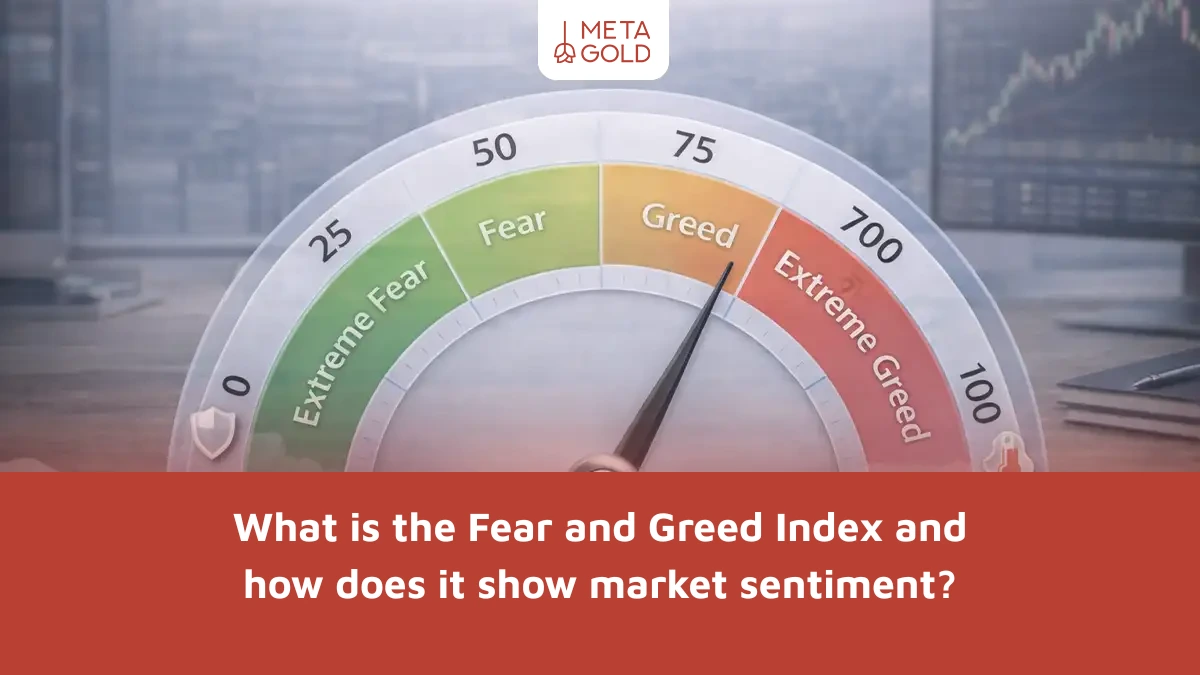
The Fear & Greed Index is a simple tool for measuring the “mood” of the market; that is, whether traders are making decisions more influenced by fear or greed at the moment. The index is usually displayed on a scale of 0 to 100: the closer the number is to 0, the more fearful and conservative the market mood is (extreme fear); and the closer it is to 100, the more excited and risk-taking it is (extreme greed).
The importance of this indicator is that the market is not driven by economic data alone; collective behavior also plays a big role. When fear prevails, many traders simultaneously move to exit, reduce risk, or sell, which can exacerbate volatility. Conversely, when greed is high, more people are driven by FOMO and rash decisions are made.
Table of interpretation of numbers of the fear and greed index
This table helps you convert the index number into a simple risk perception at a glance and control emotional decisions.
| Index Range | Market Condition | Risk Interpretation |
|---|---|---|
| 0–24 | Extreme Fear | Reduce risk exposure and only enter trades with stronger confirmations. |
| 25–44 | Fear | Keep position size conservative and be stricter with stop-loss management. |
| 45–54 | Neutral | Stick to your plan and rules; neither get excited nor overly cautious. |
| 55–74 | Greed | Be cautious of impulsive decisions and avoid letting risk get out of control. |
| 75–100 | Extreme Greed | High probability of emotional behavior; increase sensitivity to risk management. |
How does the Fear and Greed Index show traders’ sentiment?
The Fear and Greed Index is essentially a “summary”; it combines several behavioral and statistical indicators to tell whether the market is currently driven more by fear or greed. The basic idea is that when indicators such as price action, volatility, trading volume, media bias, and the collective reaction of traders converge, the emotional climate of the market becomes clearer.
For example, if volatility increases, selling pressure increases, and news and social media narratives become alarmist or pessimistic, the index will typically lean toward “fear.” Conversely, when price growth is accompanied by public excitement, increased attention, and a desire to follow the trend, the index will move toward “greed.”
The important thing to note is that this indicator does not “predict”; it simply tells you what the prevailing market sentiment is right now so that you can interpret it more accurately, along with technical analysis and risk management. The weighting of these components also varies depending on the provider.
If you want to go beyond a number and understand “market sentiment” more deeply, the Fear and Greed Index is just the starting point.
Differences in the use of the Fear and Greed indicator in Forex and Crypto
On the surface, the Fear and Greed Index has the same message in all markets: “Where is the market sentiment right now?” But the data source and how it is measured in crypto is different from forex, and this difference changes the practical application of the indicator.
Fear and Greed Index in Crypto
In the cryptocurrency market, volatility is usually more intense and reactions are faster, so “collective sentiment” can quickly influence prices. In addition to price data and trading volume, a significant part of crypto sentiment is fed by social media, trends, and public attention;
For this reason, the Fear and Greed Index in this market usually provides a more tangible picture of the excitement or fear of traders. On the other hand, the 24/7 activity of the crypto market causes emotional changes to occur without interruption, and the use of such an indicator to control emotional behaviors (such as FOMO) is more common.
In crypto, there are usually more common versions of this indicator, and traders often refer to it to get a quick snapshot of market sentiment.
Fear and Greed Indicator in Forex
In Forex, when we talk about the “fear and greed index,” we usually don’t mean a single, official number like the versions common in crypto. The currency market is more influenced by capital flows and risk-on or risk-off behavior;
Therefore, traders’ sentiment should be measured by a set of indicators. Simply put, if investors become risk-averse, money will flow into safe assets, and if they become risk-averse, riskier assets will become more attractive. This is what can indicate a “fear or greed mood” in Forex.
To measure this space, the following are usually used:
- Safe-haven assets : such as gold, Japanese yen (JPY), and Swiss franc (CHF), which usually strengthen during market fears.
- Volatility and risk climate : Like the VIX index or risk-off/risk-on indicators that tell you how worried or excited the market is.
- Macro data and bond yields : (such as changes in interest rates and yields) which form the main context of capital behavior in the currency market and help to correctly interpret sentiment.
Among safe-haven assets, gold is one of the most important markets whose behavior can help interpret sentiment during periods of risk-off and fear.
How to use the Fear and Greed indicator in trading
The Fear and Greed indicator is useful when you don’t think of it as a “buy or sell signal,” but rather as a behavioral filter to control emotional decisions. It simply tells you whether the market is more in a fear or greed environment right now, but what you do should depend on your trading plan, timeframe, and other confirmations.
Application 1: Emotion Filter (Anti-FOMO)
When the indicator is moving towards greed or extreme greed, the likelihood of hasty entries and “missing the move” increases. In these situations, turn the indicator into a warning: before each entry, only go for setups that meet your plan’s conditions and avoid following rapid moves.
Application 2: Adjusting Risk and Position Size
In the phase of extreme fear or panic, the market will usually be more volatile; so it makes sense to set your trade size, stop loss, and number of trades more conservatively. In extreme greed, you can also increase the severity of your risk management so that market excitement does not cause additional risk.
Application 3: Scenario writing (if/then) with technical validation
Turn the indicator into a scenario: “If the indicator is extremely greedy, then I will only enter on a valid breakout/confirmation of the structure” or “If the fear is extremely fearful, then I will not take action until the price reaches a key level and confirms it.” This turns the indicator from a raw number into an execution tool.
How does the Fear and Greed indicator appear in TradingView?
To see the Fear and Greed indicator in TradingView, you usually have to use the Community Indicators, as TradingView does not have an official Fear & Greed indicator for all markets by default. A quick way is to search for terms like Fear and Greed, Crypto Fear & Greed, or Fear Greed Index in the Indicators section and add one of the most popular results to your chart.
The important thing to note here is that many of these indicators actually only display data from an external source; that is, the quality of the output depends on the “data source, how it is updated, and the manufacturer’s settings.” So before relying on it, read the indicator description: Where does the source come from? How often is it updated? And is it compatible with the asset you are looking at or is it designed just for crypto?
Conclusion: The right understanding of market fear and greed
What is the Fear and Greed Index? A quick tool to gauge the “psychological climate of the market” that, on a scale of 0 to 100, indicates whether traders are predominantly fearful or greedy. In the crypto market, this indicator is usually more straightforward and widely used, but in forex it is more often interpreted as a sign of risk-taking or risk-aversion. Most importantly, the Fear and Greed Index is not intended to predict the future; its true value is when you turn it into a risk management rule and make decisions in conjunction with market structure and analytical confirmations.
Frequently Asked Questions about the Fear and Greed Index
1. What is the Fear and Greed Index?
The Fear and Greed Index is a number between 0 and 100 that indicates whether the prevailing market sentiment is towards fear or greed, providing a quick snapshot of sentiment.
2. Does extreme fear mean you definitely have to buy?
No. Extreme fear is not a “buy signal”; it is simply a warning that the market is emotional and fragile. Make the decision with technical confirmation and risk management.
3. Is there a Forex Fear and Greed indicator?
It usually doesn’t have a single, official number like crypto. In Forex, it’s more measured by risk appetite or risk aversion and big data.
4. What is the best timeframe to use the Fear and Greed indicator?
This indicator is usually better for a general market view (often daily); it should be used with caution and in conjunction with technical confirmations on very low timeframes.