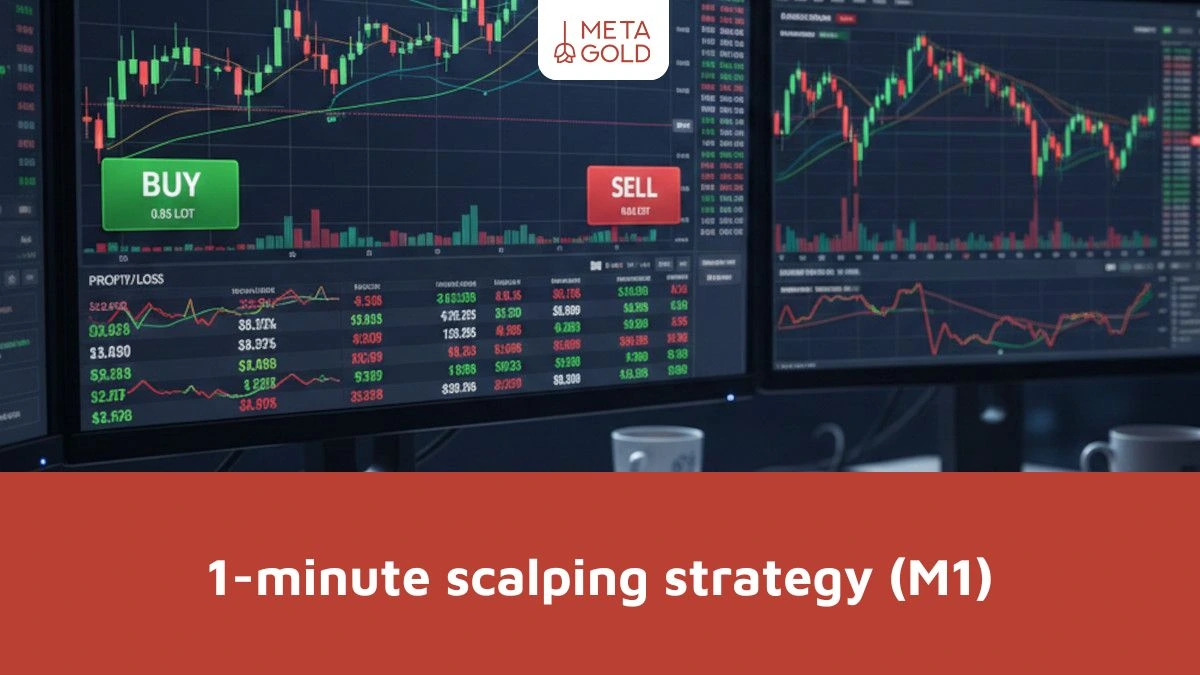

The 1- minute scalping strategy can be considered the fastest trading style in financial markets; where the trader opens and closes positions in a few seconds to a few minutes by analyzing the chart on a 1-minute timeframe to create numerous opportunities from small fluctuations.
In this article, we will first introduce the one-minute scalp, introduce suitable markets for it, and then list the indicators used for this strategy. Finally, we will examine the best scalping strategy , its advantages and limitations.
What is a one-minute scalp and what markets is it suitable for?
What is scalping? What is the one-minute scalping model? One-minute scalping means opening and closing trading positions in a very short period of time, usually between a few seconds and a maximum of a few minutes. In this method, the trader seeks to make small but frequent profits. The conclusion usually depends on risk management and transaction costs.
Characteristics of a market suitable for scalping
In order to be successful in a scalping strategy, the market in question must have certain technical characteristics. Failure to pay attention to these can drastically increase trading costs and eat up your small profits.
- Very high liquidity : The market must have a heavy trading volume so that entry and exit are possible at any time and with minimal price slippage.
- Very low spread : Since the profit of each scalping trade is low, the difference between the buying and selling price must be as small as possible so that the trade can quickly turn a profit.
- Sufficient volatility : The price must be moving; stagnant, trendless markets are of no benefit to scalpers and only waste their time.
- Stability in the trading platform : Fast execution of orders and no lag in the brokerage system are crucial for this style.
The best examples of markets suitable for 1-minute scalping are major Forex pairs such as EUR/USD, GBP/USD and USD/JPY. Also, reputable global indices such as Nasdaq or Dow Jones and even some high-volume cryptocurrencies provide an ideal platform for this strategy during peak trading times. Note that 5-minute scalping is also one of the best options for short-term trading.
Advantages, Disadvantages and Risks of 1-Minute Scalping
As profitable as the one-minute scalping strategy can be, it also has its own challenges, which are summarized in the table below:
| Advantages | Limitations | Risks |
|---|---|---|
| The possibility of making profit in a very short time | Requires very high and continuous focus | High risk due to leverage |
| A large number of trading opportunities throughout the day | Significant impact of commission fees and spread | High probability of human error in quick decision-making |
| No exposure to the risks of holding positions overnight | Mental fatigue due to the fast pace of the market | Severe volatility during the release of economic news |
Important principles before starting scalping in 1 minute
On a 1-minute timeframe, small details make the difference. Only scalp highly liquid symbols so that spreads and slippage don’t eat up small profits. Avoid trading during important news and when spreads are unusual. Keep the chart quiet (max 1 trend filter + 1 momentum confirmation) and do a quick check of the general direction on M5 or M15 before entering. Most importantly, set your risk per trade and daily loss limit before clicking the stop loss.
Types of one-minute scalping indicators
Indicators in 1-minute scalping help filter out market noise for more precise entry and exit. Below, we will introduce the best indicators for the 1-minute timeframe .
Exponential Moving Average (EMA)
In a one-minute scalp, the speed of price changes is very high, and the simple moving average cannot react quickly. The EMA indicator captures the current market trend more accurately by giving more weight to recent prices. Often, a combination of short-term and medium-term EMA periods is used to identify the direction of movement.
Stochastic indicator
This oscillator is one of the most popular tools for identifying overbought and oversold areas on lower timeframes. When the Stochastic lines cross at extreme levels, it signals a possible temporary price reversal, which is an ideal opportunity in a 1-minute scalping strategy.
Relative Strength Index (RSI)
The RSI indicator helps traders gauge the strength of the current trend. In scalping strategies, it is used to confirm divergences and determine whether the price has the potential to continue moving. The alignment of the RSI with the direction of the overall trend significantly increases the confidence factor of trades.
The best one-minute scalping strategy
To implement a successful strategy on the one-minute timeframe, you need to have a precise and unambiguous system. The strategy we have outlined below is designed based on trend confirmation and price correction hunting to minimize your trading risk.
Step 1: Identify the main trend
As a first step, before entering on M1, quickly check the general direction on M5 or M15 so that you don’t trade against the main market trend. Use two exponential moving averages such as EMA 50 and EMA 100. If the price is above both averages and EMA 50 is above EMA 100, the trend is up. On the contrary, if the price is below the averages, only look for selling opportunities. Trading in the direction of the trend is the first survival principle in scalping.
Step 2: Waiting for a price correction
After identifying a trend, do not enter the trade immediately. Wait for the price to make a temporary pullback or correction towards the moving averages. These corrections are actually opportunities where the market allows you to ride the main wave at a better price and make more profit.
Step 3: Receive entry confirmation
When the price approaches the moving averages, look at the Stochastic indicator. In an uptrend, if the Stochastic moves up from the oversold zone (below 20) and crosses, an entry signal has been issued. This final confirmation assures you that the selling pressure has subsided and buyers have re-entered the market.
Step 4: Determine the profit and loss limits
Discipline in exit is more important than entry. Set your stop loss a few pips below the last low (in a long trade). For a take profit, a target of 8 to 12 pips is usually reasonable. The target should be set according to the spread and volatility of the symbol; because in the 1-minute timeframe, the cost of the transaction and the range of price movement play a decisive role. Remember that in a 1-minute scalp, greed for larger profits can lead to the loss of the entire profit of the trade.
Money Management in 1-Minute Scalping
In M1 scalping, money management is more important than the strategy itself, because the profit per trade is usually small and a few emotional decisions can ruin the entire result of the day. Before each entry, keep the risk per trade constant (preferably low and manageable) and adjust the volume only based on the stop-loss distance, not on market sentiment and excitement.
The stop loss should be predetermined and placed where it will indicate the scenario is invalid, not just a random number. Be realistic about the take profit limit and don’t let greed get in the way; the goal of this style is repeatability. Finally, have a daily stop rule: if you hit your daily loss limit or have a series of losses, stop trading that day to avoid “taking revenge on the market” and increasing your risk.
Conclusion: One-minute scalping and short-term profit making
There are many opinions on the best timeframe for scalping, but the 1-minute scalp remains one of the most popular choices. Trading the 1-minute scalping strategy is a skill that helps traders take advantage of small fluctuations in the Forex and other financial markets and improve their trading performance if executed consistently and with risk control.
This style requires mastering technical tools, choosing a broker with low spreads, and most importantly, maintaining focus and discipline in making quick decisions. By following the principles of money management and sticking to a proven plan, M1 scalping can be turned into a measurable and repeatable trading method.