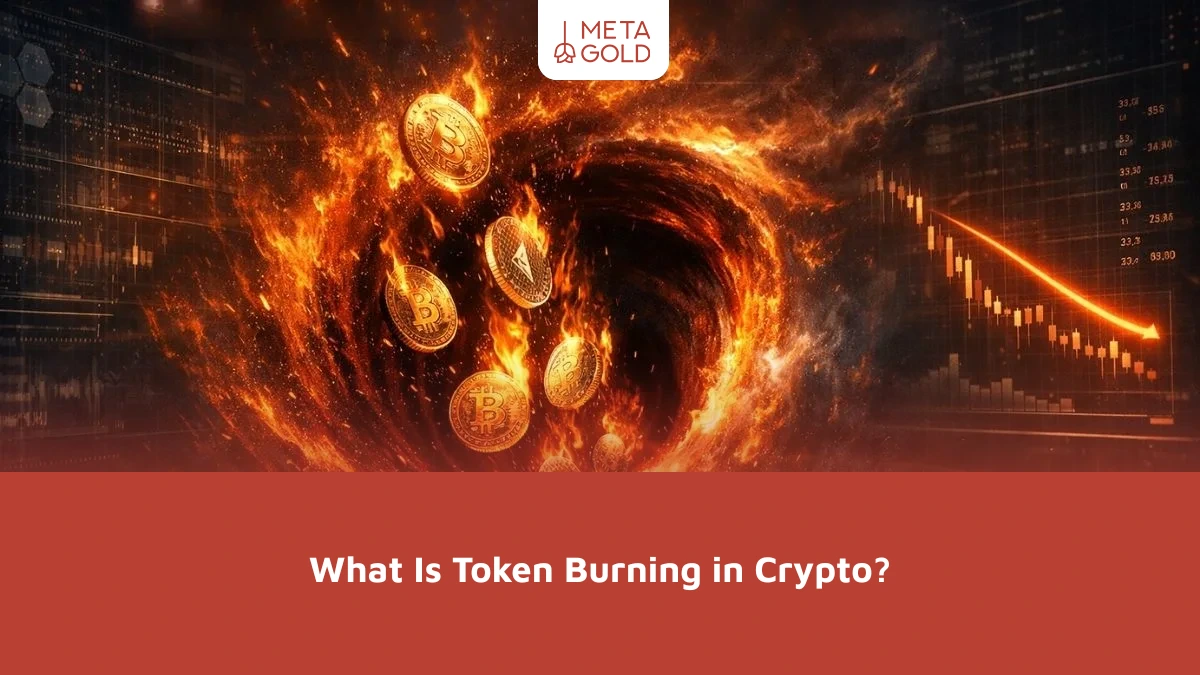

What is token burning in cryptocurrency? And why do projects permanently remove part of their assets? Many users assume that any decrease in supply means a definite increase in price, while the relationship between supply, demand, and value is much more complex than this simple perception.
In this article, we will examine how token burning is done, what impact token burning has on currency prices, what applications it has in different economic models, and most importantly, when it can be a positive sign and when it can simply be a promotional tool.
Definition of token burning and its role in reducing supply
Token burning is the process by which a certain number of tokens are permanently removed from the supply. This permanent removal reduces the circulating supply and is deflationary in nature. In this process, the tokens are sent to a special address called a burn address or eater address. This address is designed to only receive tokens and has no recoverable private key. For this reason:
- Assets sent to it can never be spent.
- They cannot be re-transferred.
- Tokens will be permanently removed from supply.
How does token burning work?
The important question for investors is what effect token burning has on the price of the currency. And whether this supply reduction will lead to sustainable growth. This process usually begins with a formal decision by the project team or sometimes the community of token holders. They determine how many tokens should be permanently removed from circulation. This decision can be part of the project’s economic plan.
After this step, the selected tokens are sent to a special address called the burn address. This address has no private keys available. In simple terms, it is like a safe with no way to open it. Once the tokens are transferred to this address, they can no longer be spent or transferred and are effectively gone forever.
This transaction is recorded on the blockchain and can be viewed by any user. This transparency makes the burning process verifiable and reliable. After the transaction is completed, the circulating supply decreases. In some token contracts, the totalSupply also decreases if the burn function is designed to update totalSupply.
Photo 2: The process of burning tokens on the blockchain with transfer from a wallet to a burn address, with transaction confirmation in explorer and transparent display in the ledger
Types of token burning methods
Token burning can be implemented with different structures and goals. Familiarity with the different token burning methods will help you better analyze the economic model of projects. The most important methods are:
- One-time token burn: The project permanently removes a certain amount of tokens from circulation at a specific event.
- Periodic token burning: Burning occurs at specific time intervals to gradually reduce the supply.
- Automatic token burning: The burning mechanism is built into the network code and is executed without manual decision.
- Fee-based token burning: A portion of transaction fees is automatically burned, helping to gradually reduce the supply.
Why is token burning important?
Token burning is not just a technical measure to remove part of the supply, but also a strategic tool in designing the economy of a project. Many blockchain teams use this mechanism to manage supply, strengthen trust, and create balance in the market. The importance of token burning can be summarized in a few main points:
- Supply control and inflation management: Reducing the number of tokens in circulation creates scarcity.
- Creating price stability: In some stablecoin models, tokens are minted when users deposit collateral or fiat reserves and burned when users redeem them. This can help align supply with backing or demand, but the mechanism differs across stablecoin types.
- Increase investor confidence: A transparent and planned token burn can demonstrate the team’s commitment to supply management and the economic sustainability of the project.
- Greater community engagement: In projects with a governance structure, users can vote on the implementation of token burns.
In projects that use governance tokens, token holders may be able to vote on the implementation of token burns and participate in the network’s economic decisions. In some models, especially certain stablecoin projects, the token minting and burning mechanism can be automated to help keep the price within a target range. If you don’t know what a stablecoin is , it’s simply an asset that attempts to maintain its value relative to a reference asset.
What impact does token burning have on price?
One of the most common questions is, does token burning cause an increase in price? The short answer is not always. However, the actual impact of a token burn depends on a few important factors:
- Market perception: If investors see the token burn as a sign of commitment and proper supply management, demand may increase; but if they see it as a promotional move, its impact will be limited.
- Token burn rate: The greater the volume of tokens burned relative to the totalSupply, the greater the likelihood of price impact.
- General market conditions: In bull markets, a reduction in supply can have a reinforcing effect; but in bear markets, even extensive burning may not change the trend.
- Project fundamentals: If the project lacks a strong application, technology, or economic model, token burning alone cannot generate sustainable price growth.
Applications of token burning in cryptocurrencies
Token burning is not just done to reduce supply, but also has a practical role in various parts of the blockchain ecosystem. The most important use cases are:
- Anti-inflation mechanism: Some projects build periodic burning into their code to gradually reduce supply and reduce concerns about inflation or excessive dilution of tokens.
- Algorithmic stablecoins: Some algorithmic stablecoin models use minting and burning mechanisms to adjust supply, but these mechanisms are risky and do not always maintain a stable peg.
- Reward and Participation Mechanisms: In some networks, reducing supply can enhance the value of participants’ rewards.
- Artistic and conceptual projects: In the field of digital art and NFTs, burning can be used to create scarcity, unlock access, or emphasize the uniqueness of digital works.
If you are wondering which cryptocurrency has token burning , you should know that many projects have incorporated this mechanism into their economic model.
Transparency and Verifiable Token Burns
One of the most important features of token burning is its public verifiability and auditability. Unlike many traditional financial mechanisms, the details of which are not publicly available, the token burning process is recorded directly on the blockchain. This means that any user, analyst, or investor can view the burn transaction in a blockchain explorer and verify its authenticity.
In practice, the burn address is publicly visible and its balance is transparent. So the exact amount of tokens transferred to this address and the time of the transaction are fully traceable. Also, after the burn is performed, the circulating supply is updated, and in contracts that support a burn function, totalSupply may also be updated.
Advantages and disadvantages of token burning
Token burning is used in the economic design of many blockchain projects as a supply management tool. This mechanism can help improve the structure of tokenomics if implemented purposefully; however, it has limitations and should not be considered a surefire solution to price growth. A proper assessment of token burning is possible when its benefits and risks are considered together.
| Advantages of Token Burning | Disadvantages of Token Burning |
|---|---|
| Permanently reduces supply and helps prevent excessive dilution | It does not guarantee a price increase |
| Creates scarcity and strengthens the logic of supply and demand | Its impact may be short-term and driven by market hype |
| Sends a positive signal to the market about supply management | It will be ineffective without strong utility and solid fundamentals |
| Offers high transparency because transactions are publicly recorded on the blockchain | The market may interpret it negatively or view it as a promotional tactic |
| Helps support price stability in some economic models | If used merely as a marketing tool, it can reduce market trust |
| Shows the team’s commitment to the roadmap and long-term goals | — |
Is token burning always a positive sign?
Token burning can send a positive message about supply management and the team’s commitment to economic sustainability, but it is not a definitive measure of a project’s value alone. Supply reduction only makes sense when other parts of the project are also structurally and operationally strong. When evaluating a cryptocurrency, it is important to consider the following factors:
- Project goals and roadmap: Is the token burn part of a long-term, specific plan or a one-time action without a clear strategy?
- Economic model or tokenomics: What is the logic behind the distribution structure, how tokens are created and consumed, and the balance between supply and demand?
- Team transparency: Is information about burning, supply, and economic decisions publicly available and verifiable?
- General market conditions: Bullish or bearish market conditions can strengthen or weaken the effect of token burning.
Conclusion
Token burning is one of the important tools in supply management, but the answer to the question of whether token burning causes price increases? It’s not always certain. As we’ve seen, reducing supply can help drive value growth under the right circumstances, but the foundation of the project, the level of demand, and market conditions play a decisive role.
FAQ
What effect does token burning have on currency prices?
In theory, a decrease in supply can cause prices to rise, but in practice, market conditions, demand levels, and the project foundation are the determining factors.
Will token burning cause price increases?
Not necessarily. Even reducing supply cannot create sustainable growth if the project has no real application.
Which cryptocurrency has a token burn?
Many projects have a burn mechanism, especially some networks with a deflationary model or algorithmic stablecoins.
What are the types of token burning methods?
Burning can be one-time, periodic, or automated in the network code, and is usually done by sending tokens to an unreachable address.
What are the advantages and disadvantages of token burning?
Advantages include reduced supply and increased transparency; disadvantages include short-term or ineffective effects if the project foundation is weak.