
In financial markets, sometimes the price briefly breaks a support or resistance level just before a strong move begins, triggering many traders’ stop-loss orders, but then immediately resumes its original path. This market behavior is called stop hunting.
Stop hunting occurs when price moves into an area with a large volume of stop-loss orders. As these orders are activated, liquidity is created for larger market moves, and retail traders are usually exited. Understanding this concept helps traders place their stop-losses at safer points and avoid fake-outs.
In this article, we will explore what stop hunting is, why it happens, and how to recognize it or use it in a trading strategy.
What Is Stop Hunting? Definition and Core Concept
Stop hunting is a situation in financial markets where the price temporarily moves to an area where a large number of traders have placed stop losses. When the price reaches these areas, stop loss orders are activated, causing a sudden increase in trading volume and creating liquidity in the market. After this liquidity is collected, the price often moves in the main direction of the market.
Simply put, stop hunting occurs when the market first kicks traders out of their positions and then begins its main move. This is usually seen around important support and resistance levels, previous highs and lows, and breakout areas, where many traders place their stop-losses.
In fact, the market needs liquidity to continue making big moves, and one of the easiest ways to provide this liquidity is to activate stop-loss orders for retail traders. This is why stop hunting is seen in many markets such as Forex, cryptocurrencies, and even the stock market.
For this reason, professional traders try to identify where stop losses accumulate, as these areas are often the same areas where liquidity hunting or stop hunting is most likely to occur.
Why Does Stop Hunting Happen?
Stop hunting usually occurs because traders’ stop losses accumulate in a specific area. Many traders place their stop losses in similar locations, such as below support, above resistance, or behind previous highs and lows. As a result, a large volume of stop orders accumulate in these areas.
When the price reaches these areas, a large amount of liquidity enters the market with the simultaneous activation of stop-losses. This liquidity can provide the necessary conditions for the price to continue moving.
For this reason, in many cases the market first touches these areas, stops are activated, and then the price continues to move in the main direction.
In liquidity-based approaches such as ICT, this market behavior is considered a natural part of the price movement structure.
How to Identify a Stop-Hunt on a Chart?
Spotting a stop-hunt on a chart is an important skill for traders. It usually occurs when the price briefly breaks a key level, such as support, resistance, or a previous high or low, but quickly returns to its previous range.
One of the most common stop-hunting signals is long wick shadows around key levels. In this case, the price briefly crosses the level, stops are triggered, and then the market moves in the opposite direction.
Also, in many cases, stop hunting occurs near important liquidity areas or trading structures such as order blocks. For this reason, examining the market structure and identifying these areas can help traders better identify the possibility of stop hunting. To learn more about this concept in market structure, it is recommended to also read the article What is an Order Block ?
In What Areas of the Chart Does Stop Hunting Occur Most Often?
Stop hunting usually occurs at points on the chart where a large number of traders have placed their stop losses. These areas become important sources of liquidity in the market due to the accumulation of orders and are more likely to trigger a price reaction. The most important of these areas are:
Previous highs and lows
- Many traders place their stop loss behind the previous high or low.
- For this reason, the price sometimes crosses these areas for a short time and then returns to the previous range.
- This short movement can trigger a large number of stops.
Important support and resistance levels
- Clear support and resistance levels are one of the most common places for stop-loss orders to accumulate.
- A short-term break of these levels can usually be a sign of a stop hunt.
- After the stops are triggered, the market often continues to move in the main direction.
Above or below trend lines
- Some traders place their stop loss behind the trend line.
- For this reason, a rapid break of the trend line and price reversal could be a sign of stop hunting.
Important areas of liquidity and market structure
- In many cases, stop hunting occurs near important structural areas of the market.
- These areas are usually home to major market players.
- For this reason, examining price structure and liquidity can help better identify these movements.
The Difference Between a Stop Hunt and a True Breakout
One of the most important skills in trading is knowing the difference between a stop hunt and a true price level breakout. Many traders lose money because they consider every price break through an important level as a valid breakout.
In a real breakout, the price stays in the same direction after breaking through support or resistance, and a new market structure usually forms. In this case, the market tends to continue moving and pullbacks are often limited and controlled.
In contrast, a stop hunt or false breakout usually occurs with a quick, short-term move. The price crosses the level to activate the stop loss, but soon returns to the previous range and continues its original path in the opposite direction.
In short:
- A true breakout is associated with price acceptance beyond the level and continued movement.
- Stop hunting is seen with a rapid price reversal and long shadows of the candles.
- A stop hunt is often about collecting liquidity, not creating a new trend.
Practical Example of Stop Hunt on a Chart
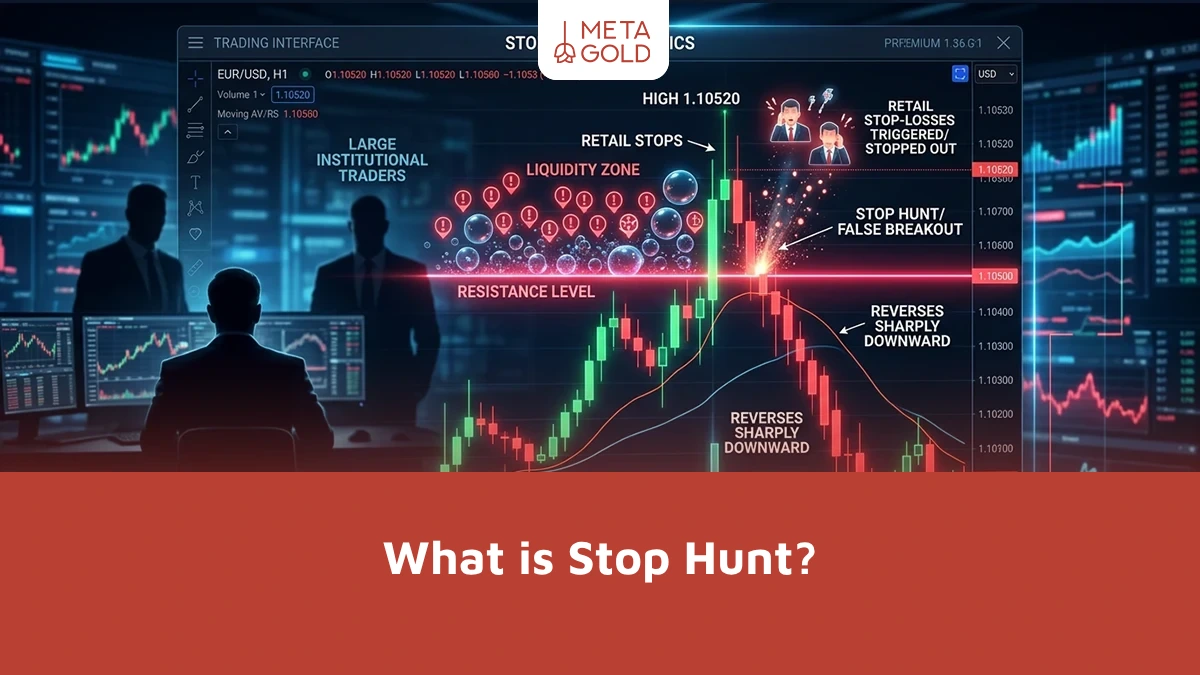
Suppose the price has reacted to a resistance level several times and many traders have entered a short position behind this resistance. In such a situation, many of them will place their stop loss slightly above the resistance.
At one point, the price breaks through the resistance with a rapid move. Stop losses are triggered and trading volume suddenly increases. But this move is not sustained; the price quickly falls back below the resistance and then begins a strong downward move.
This scenario is a classic example of stop hunting, where the market has first gathered the necessary liquidity and then started its main move. Traders who entered the trade based solely on the level breakdown will exit the market, while professional traders will enter the appropriate position from this area.
Common Mistakes Traders Make When Dealing with Stop-Hunting
Many traders fall into the stop-hunting trap due to a few common mistakes. Recognizing these mistakes can go a long way in improving your trading performance.
- Placing a stop loss just behind clear support or resistance
- Rushing into a trade immediately after a level is broken
- Ignoring the overall market structure and underlying trends
- Trading without paying attention to the behavior of candles and shadows
- Not using additional confirmations such as volume or higher timeframes
These mistakes put the trader in the exact same area where the market is looking to hunt for liquidity.
What is the Stop Hunting strategy and how does it work?
The stop hunting strategy is a liquidity-based trading method in financial markets. In this strategy, the trader tries to identify areas where other traders are likely to place stop-loss orders. After price moves into these areas and those stops are triggered, the trader waits for the price to reverse and then enters a trade in the direction of the main market movement. This method is usually used near previous highs and lows, important support and resistance levels, and liquidity areas.
How to use stop hunt in a trading strategy?
Contrary to what many traders think, stop hunting is not just a threat; it can also be used as a trading opportunity. Professional traders usually use stop hunting to their advantage rather than fearing it.
One common approach is to wait for a stop hunt to occur and then enter in the direction of the main market move. For example, after a fake breakout and a quick price recovery, one could look to enter in the opposite direction of the breakout.
- To better use stop hunting in your trading strategy:
- First, identify areas of liquidity accumulation and stop-losses.
- Wait for the price to react and return to the previous range.
- Enter the trade after confirming the market structure.
- Place the stop loss in an area that is less prone to hunting.
Summary of the Stop Hunting Strategy
Stop hunting is a natural and recurring behavior in financial markets that usually occurs around important price levels. This phenomenon occurs with the aim of accumulating liquidity and activating stop-losses for retail traders, and is often seen before major market moves.
Understanding the difference between a stop hunt and a true breakout, examining market structure, and paying attention to price action in key areas can help traders make more informed decisions. Instead of fearing stop hunts, understanding them properly can help traders use these moves as part of their trading strategy and avoid the trap of fake breakouts.
Frequently Asked Questions about Stop Hunt
What is Stop Hunt?
Stop hunting is a situation where the price briefly moves into an area where a large number of traders have their stop losses set. When these stops are triggered, liquidity enters the market and the price usually continues to move in the main direction.
Does stop hunting happen in all financial markets?
Yes, stop hunting is seen in almost all financial markets such as Forex, Cryptocurrencies, Stock Markets and even Commodities. Any market where stop loss orders exist can witness this kind of price behavior.
How to identify a stop-hunt on a chart?
Stop hunting can usually be identified by signs such as a short-term break of a key level, a rapid price return to the previous range, the formation of long candlestick shadows, and a sudden increase in trading volume near key levels.
What is the difference between a stop-hunt and a true breakout?
In a true breakout, the price moves in the same direction after breaking through a support or resistance level, forming a new market structure. But in a stop hunt, the price only briefly crosses the level and then quickly returns to the previous range.
How can you avoid getting caught in a stop hunt?
To reduce the chances of getting caught in stop hunting, it is better not to place the stop loss exactly behind clear levels, to examine the market structure and overall trend, and to obtain necessary confirmations from price action before entering a trade.